

This Care Needs Assessment Guide is designed to help families identify when an older parent or relative may need additional support and to help you understand how to access the care services you need to improve the quality of life for your loved one. You may notice a family member struggling to prepare their own meals, forgetting to take important medication, finding it difficult to move safely around the home, or being unable to manage their personal care and hygiene without help.
This was the situation I faced with a close family member. As their health deteriorated, I gradually took on more and more responsibility for their daily care. I did their shopping, prepared and served all of their meals, assisted them with their personal hygiene to ensure they remained clean and comfortable, completed household cleaning and laundry, and administered their medication because they had started to forget when to take it. I also had to make sure they were safely settled in bed before leaving.
Eventually their needs became so overwhelming that they were no longer able to manage most aspects of their daily living independently. Recognising that they required additional support, I contacted Adult Social Services at our local council and requested a Care Needs Assessment. This assessment was the first step towards ensuring they received the professional care and assistance they needed to remain safe at home, and maintain the best possible quality of life.
What Is a Care Needs Assessment?
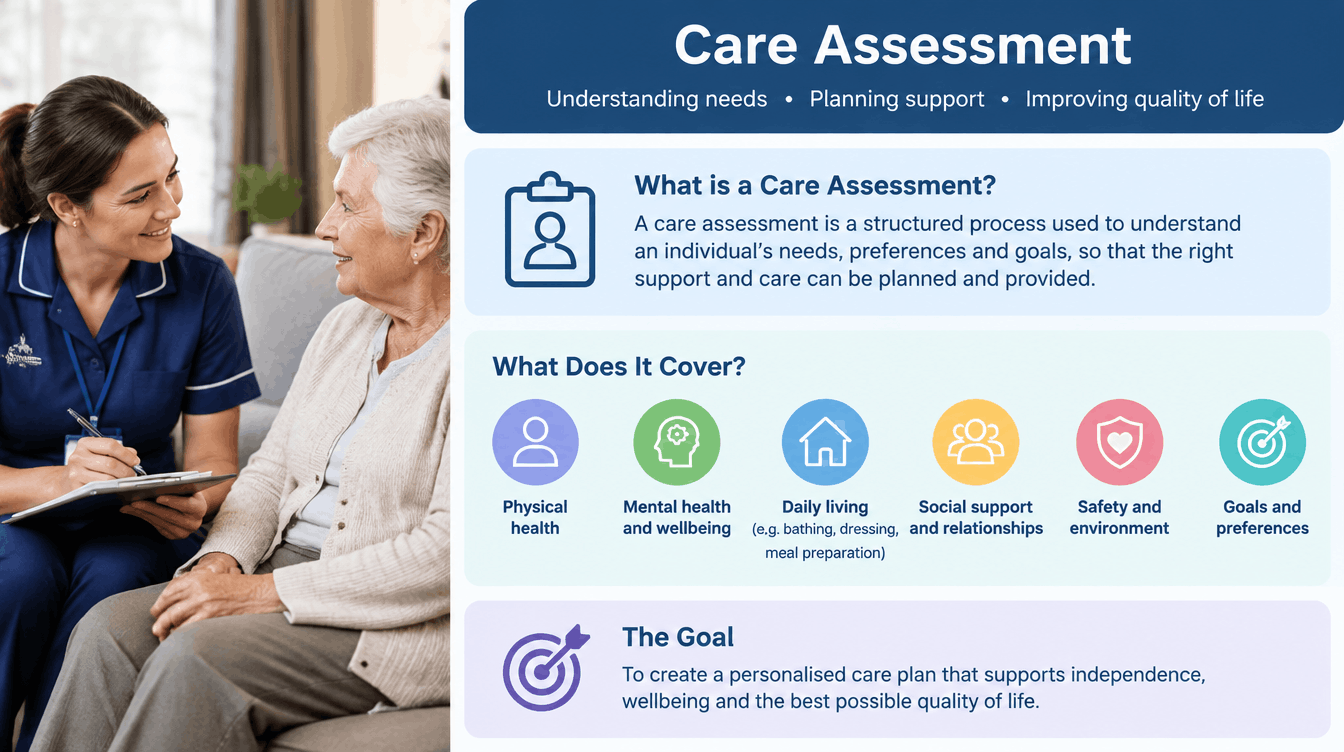
A care needs assessment starts with a conversation with the council’s adult social care team. It looks at what a person manages to do on their own, what they find difficult, and what help they need to make their life better and safer. This check list will help you to understand the questions that you will be asked during the assessment. They cover every aspect of the older person’s life including their personal care, food, hydration, medication, mobility, social contact and isolation, cognitive ability, safety, beliefs, routines, and personal wishes.
Why Should My Loved One Have One?
Being able to do something now and again does not mean it can be done safely every day. Many families delay arranging a care needs assessment because their loved one insist that they are managing well. On good days, they may appear independent and capable of carrying out everyday tasks. However, ageing, illness, mobility problems, or memory difficulties can make daily life unpredictable. An older person who copes one day may struggle the next.
What often starts as a small concern can quickly become a serious safety risk. For example, an older person living without care on their own may forget to switch off the grill, drop a pan of hot water while cooking, become stuck getting out of the bath, forget to take their medication, take their medication twice by mistake or fall at home. These incidents can lead to significant injuries and may reduce their confidence and independence.
An adult social care needs assessment can identify risks that older people have gradually come to accept as part of everyday life. It provides a professional evaluation of the support an older person needs and is designed to help improve their home safety, well-being and maintain their independence by ensuring that the right care is in place before a crisis occurs.
The aim of a care needs assessment is to work out whether you can do certain tasks like:
- Carry out your own personal hygiene by washing yourself regularly, dressing and changing your clothes to keep clean and healthy
- prepare and eat food without help and get enough to drink
- use a toilet and manage all your toilet needs
- dress yourself properly
- move around your home safely
- keep your home safe and habitable
- have enough contact with other people
- take part in activities, like volunteering, training or learning
- use services including public transport and local shops.
If your needs often change, the care professional may have to visit you more than once to make sure all your needs are properly assessed over time.

How Can the Care Assessment Help Our Family?
The care assessment can provide necessary support for an older person who is struggling to live a normal healthy life. It allows an older person to say exactly what support they need and what they can and cannot do on a daily basis. They can also say what is important to them and what help and support they need, such a more regular and safer bathing, attending church on Sundays, returning to a lunch club, going shopping with support or having someone to talk to at home.
For the family, concerns and worries become a detailed written record of their needs and can help to determine exactly what help and support is needed. It may show that one daughter cannot visit three times daily or that an older spouse is struggling with daily tasks. An unpaid carer can request a separate carers assessment covering their health, employment, rest, and ability to continue, as explained in the Carers UK carer’s assessment guidance.
Who Completes the Assessment?
The council arranges the local authority care needs assessment through adult social care. A social worker, occupational therapist, or another trained professional may complete it at home, over the phone, online, or in hospital. You can ask for a face-to-face visit at home if it’s easier. A relative or friend can attend, or an independent advocate may be arranged if no one else is available to support you.
Is an Adult Social Care Assessment Free?
Yes, a council adult social care assessment is free and available to anyone who appears to need care and support. Having an assessment does not depend on your income, savings, or property ownership. These factors are only considered later if you are found to need on-going care and support services.
If care is required, the local authority will carry out a financial assessment for care to determine whether you are eligible for funded care support or whether you will need to contribute towards the cost of your care. The amount you pay will depend on your financial circumstances, including your income, savings, and in some cases, property ownership.
If you choose to arrange a private care assessment, there is usually a fee for this service.
At the time of writing (September 2026), people with savings and assets exceeding £23,250 are generally expected to pay the full cost of their care. Those with capital between £14,250 and £23,250 may be required to contribute towards the cost of their care, with the amount depending on their financial circumstances. Individuals with savings below £14,250 may still be asked to contribute from their income, such as their pension, but their capital is not normally included in the financial assessment.
It is important to remember that any entitlement for financial care support can vary depending on individual circumstances, so obtaining a care needs assessment and financial assessment is the best way to understand what help may be available and how much this will cost you.

How Do I Request an Assessment?
You should contact adult social care at the council where your relative lives; the GOV.UK council finder locates the correct service from a postcode. The person can request it, or a relative, friend, GP, nurse, or carer can contact the council with their permission. Give a clear example, such as “mum has fallen twice this month, she cannot wash herself on her own, and she missed 4 evening medication doses last week.” Mention if the older person is not eating, has repeated falls, wanders frequently, is experiencing possible abuse, or has a home carer who cannot continue to support them.
How Long Does The Assessment Take?
There is no defined waiting period for a care assessment, as the timing depends on the person’s needs and risk level and also the level of demand from your local adult social services department. Age UK care needs assessment guidance says families can request an expected date and an explanation if the waiting time seems too long. Mention any concerns in detail such as any new falls, hospital visits, medical changes, or the loss of family help and ask for an urgent review.
Care Needs Assessment Preparation Checklist
Written notes can prevent important details from being missed or forgotten during an emotional conversation. Gather what you have, but do not delay the request for an assessment because one document is missing. Keep the information together in a folder or on your phone so it’s easy to find during the appointment. Try to keep a daily diary of any changes in behaviour, ability to do basic tasks or any concerns that you have.
You will also need to provide:
- Full name, address, date of birth, NHS number, and GP details
- Any health and medical conditions, recent hospital stays, and current medication
- Falls, accidents, confusion, missed meals, or medication mistakes
- Tasks the person cannot complete without help
- Tasks that cause pain, fear, exhaustion, or take far longer than expected
- Help provided by relatives, friends, neighbours, or paid carers
- Equipment already in the home and any problems with it
- Eating, drinking, continence, sleep, or memory concerns
- Cultural, religious, communication, and dietary needs
- Activities and relationships the person wants to maintain
- Support the person feels comfortable receiving
- Questions you want the assessor to answer
A care diary covering one or two weeks can show patterns that are difficult to remember during one meeting. Record what happened, when it happened, who helped, and the likely risk if nobody had been present. Include ordinary difficulties and near misses, since the absence of a serious accident does not mean that the person is safe.
- Example one: “Tuesday, 8:00 a.m. Dad could get out of bed without support. It took 35 minutes to help him to wash and get dressed, and he became breathless twice.”
- Example two: “Thursday evening, Mum heated soup and left the hob on. Her neighbour noticed the smell, and this was the second time in six weeks.”

12 Top Tips for Preparing for a Care Assessment
1. Describe a Difficult Day
Do not base every answer on the person’s best morning. Explain how often fatigue, confusion, mobility issues, poor sleep, or low mood affects ordinary daily tasks. For example, If problems happen 3 days each week, say so and describe problems and the help needed on those days.
2. Give Real Examples
General statements do not give the assessor enough information about the support needed so give as as much information as possible about the difficulties and needs, for example “Dad struggles with preparing and even eating food” ”My mum cannot stand long enough to cook and just eats biscuits when nobody visits.” Add dates when incidents occur or the frequency of these so the assessor can see that the problem is repeated.
3. Explain Every Reminder
Reminders, written notes, alarms, and repeated calls all count as help. For example, If you have to call your mum 2-3 times each day to remind her to take her medication then record this and tell the assessor that she is not managing medication properly on her own. Explain who reminds her each day, how she is reminded, how often she has to be reminded and what happens when that person is not available.
4. Record The Near Misses
A serious accident does not need to happen before a danger is in need of attention. Keep a record of any slips, falls, burnt pans, doors left unlocked, overflowing baths, getting lost whilst shopping, and the number of times someone had to be called to prevent harm or injury from happening. These examples show what could happen without regular support in place.
5. Be Honest Regarding Family Help And Support
Families sometimes continue while exhausted because they feel guilty about saying no. State which visits can be realistically be done and which cannot continue because of work, child care, travel distance, illness, home care or poor sleep. The final care plan should not treat unpaid care as permanently available.
6. Let Your Relative Speak First
Give your relative time to explain their wishes, instead of answering every question for them. Add information respectfully if they forget an incident or play down a problem. Ask for a private conversation if discussing continence, memory issues, or carer strain that causes distress.
7. Explain How Long Tasks Take
An older person may be able to dress themselves but it could take them an hour and a half, require several rest periods, and cause them pain. Explain how long each task takes and if they can repeat it later in the day or not. Recording the time taken to do different tasks, when pain is experienced, safety concerns, and the ability to repeat tasks, are all important in helping to make decisions about the support needed.
8. Include Night-Time Needs
Focusing only on day-time questions can mean that you miss the care needs during the hardest part of the day for an older people and their carers. Record toilet visits, wandering, pain, calls for help, in continence issues at night, bedding changes, and interrupted sleep. Explain how this affects the behaviour and ability to do daily tasks the next day, especially if their is not a live in carer or the carer works, has family demands or has health problems.
9. Arrange Communication Support Early
Tell the council if your relative needs an interpreter, hearing support, large print, extra time, or a face-to-face meeting. Ask for information in a format they understand and request that the assessor speaks directly to them. Communication problems should never be mistaken for ignoring care needs.
10. Request a Carer’s Assessment
The older person’s assessment records their needs, while a carer’s assessment records the effect of being a carer on the unpaid carer. Both assessments can be made at the same time during the same period but they should be treated a separate assessments. Request both if caring affects sleep, health, employment, relationships, or time away.
11. Take Notes During the Meeting
Write down the assessor’s name, agreed actions, dates, and every service discussed. Ask when the written decision will arrive, then check that it reflects the complete discussions of the meeting. If important information is missing, request a correction promptly and keep a copy.
12. Ask What Happens While You Wait
The final decision may not arrive straightaway, but the person may need help during that period. Ask if temporary care, equipment, community support services, or safeguarding action can begin earlier. Record who will arrange each action and find out when the family should receive an update on the assessment and the final decision.

What Happens During the Assessment?
The assessor will ask the older person to describe an ordinary day, including their personal care, food preparation, medication, mobility, social contact, and safety. Honest answers help them to record the actual care needs, even when questions maybe embarrassing. If your relative only showers when you visit once a week and only when you visit, explain that they cannot manage to have a shower on their own without some assistance, and describe what happens when you are away.
Discuss both the difficult and better days, especially if pain, fatigue, or confusion varies from day to day. Care support is only available for tasks that cannot be completed safely without help, without severe distress, or within a reasonable time, as stated in the Care and Support Eligibility Criteria Regulations.
What Happens After the Assessment?
Following the assessment, the local council should provide the older person and their family with a copy of the assessment and its decision, giving them the opportunity to review the findings and ensure they accurately reflect their needs. If the council decides that care and support are needed, a personalised care and support plan will be developed. The care plan outlines the person’s assessed needs, the outcomes they wish to achieve, the services that will be provided, and how those services will be delivered.
Depending on individual circumstances, social care support may include home care visits, specialist equipment, adaptations to the home, meal services, respite care, supported living arrangements, or residential care. Some people may also be eligible for a personal budget or direct payments, allowing them greater choice and control over how their agreed care is arranged.
If any care services are subject to charges, the council will usually carry out a financial assessment to determine how much the person may need to contribute. It is important to ask for a clear written breakdown of any expected costs so there are no unexpected charges later on.
Taking the Next Step as a Family – For A Care Needs Assessment
Applying for a care needs assessment can feel overwhelming at first, especially if you’ve never dealt with adult social care services before. I remember feeling unsure whether my mother would be eligible for any support as her independence gradually declined and everyday tasks became increasingly difficult.
When the assessment took place at home, the assessor spoke directly with my mother about her daily routine and the challenges she was facing. To help prepare, I had kept a diary detailing the support I provided, including cooking, cleaning, shopping, laundry, and other day-to-day tasks. With my mother’s permission, I also shared my concerns about her safety, particularly her increasing risk of falls and the difficulties she was beginning to experience around the home. The assessment lasted around an hour, and the assessor carefully reviewed the information we provided. A few weeks later, we received the decision, and shortly afterwards my mother began receiving the support she needed.
Looking back, what initially seemed like a daunting process became much more manageable once I understood what was involved and prepared in advance. Having a personalised care plan in place has made a tremendous difference, reducing pressure on our family while helping my mother maintain her independence, dignity, and quality of life. If you are caring for an older relative and are unsure where to start, don’t be afraid to request a care needs assessment. Asking for help is not a sign of failure. It is often the first step towards accessing the practical support that can make everyday life safer, easier, and more manageable for everyone involved.
It’s also worth noting that some people with complex, long-term health needs, such as advanced dementia or those requiring end-of-life care, may be eligible for NHS Continuing Healthcare (CHC), where care is arranged and funded entirely by the NHS. The assessment process for NHS Continuing Healthcare (CHC), is separate from a local authority care needs assessment and can be considerably more complex. In a future article, we’ll explain NHS Continuing Healthcare (CHC) in more detail, including who may qualify, how the assessment process works, and what families can do to prepare when applying for this important source of support.